Preface
The rapid catch-up of modern Japan and contemporary China over the West rests on one premise: sincere comparison with the West, humble learning, retaining strengths while discarding weaknesses, so as to overtake later. A frog at the bottom of a well is doomed to a short life!
| Status | Canada / West | China | Fort Eire Future |
|---|---|---|---|
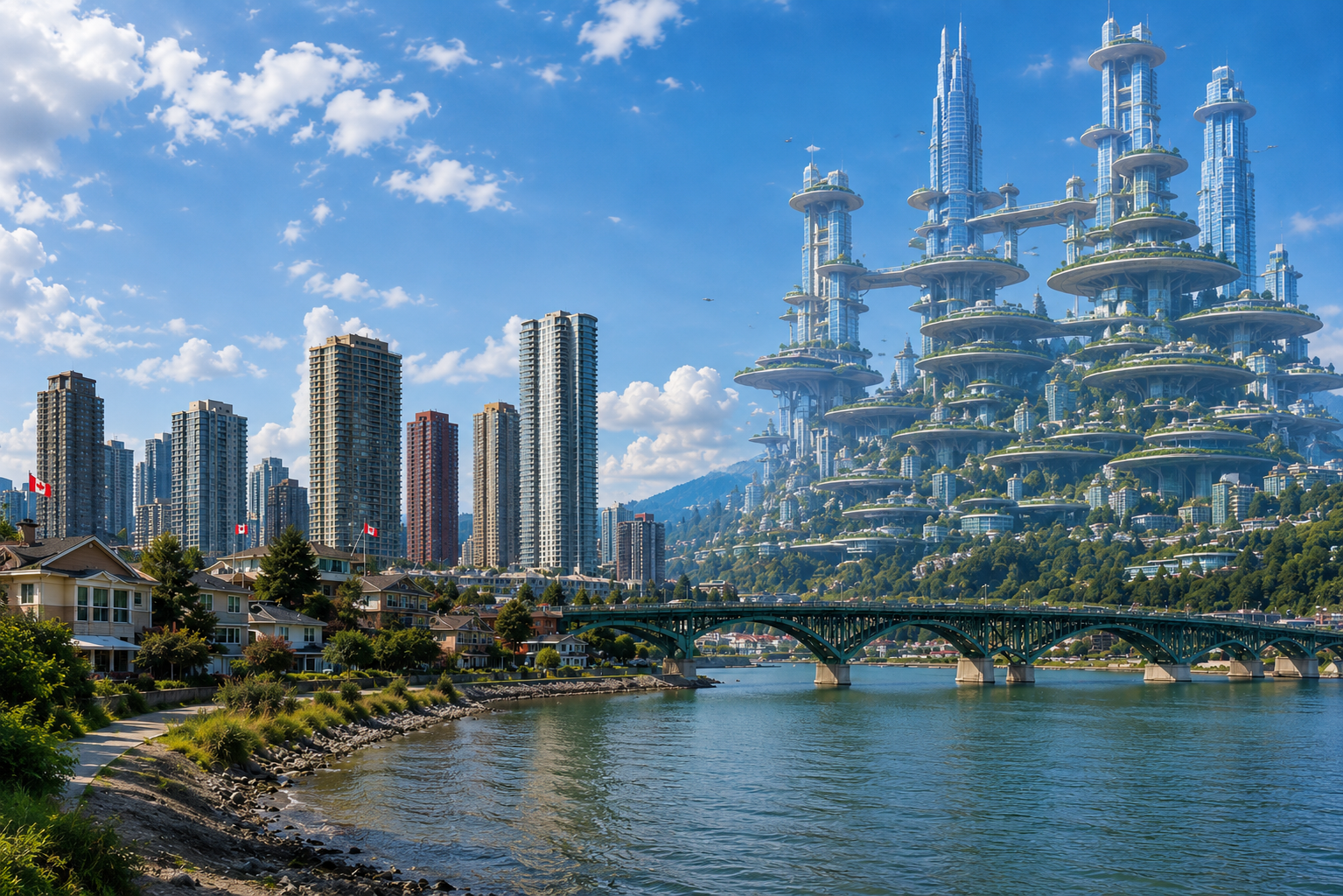
| Area | Approx. 9.98 million km² (second largest in the world); per-capita effective land and water resources rank first globally. Everyone should live as a top-tier tycoon for life. | Approx. 9.60 million km²; per-capita area and family assets only 1/40 of a Canadian’s. | Approx. 166 km². Building just one of our invented aerial mountain-city towers occupies only 2 km² yet yields 640,000 double-storey apartments and 100 indoor plazas, adding nearly one million km² of living space. |
| Geography | The most suitable temperate oceanic climate on Earth for human life; abundant resources—oil, minerals, forests, fish, grasslands—reaping unearned gains. | High plateaus and cold zones, temperate deserts, alternating dry-heat and rain disasters of monsoon climate, plus humid subtropical heat; dominated by deserts and mountains; frequent typhoons and floods (solvable by our top patents). Living and construction difficulty dozens of times that of Europe and America. | Possesses one of the Great Lakes that hold nearly two-fifths of the Earth’s fresh water—Lake Erie and its sole connecting river; vast plains, forests and grasslands; adjacent to Buffalo, USA and the world’s most beautiful natural waterfall; favourable weather, fertile soil, extremely easy for industry, agriculture, fishing and animal husbandry. |
| Population | Approx. 41.3 million. Without immigration, local population steadily declines and struggles under ageing. | Approx. 1.41 billion. In recent years, by following Western disguised sex-trade, dog-keeping and other anti-human institutions, population decline and ageing have accelerated. | Approx. 37,000, ageing, immigration about 17 %. If the scientific “the more people the better” natal policy is implemented, it can fully support the national population. |
| Life expectancy | Around 70-plus years; average for the powerful about 80-plus. | Average life expectancy already near 80; high officials trend toward 100. | Once our scientific hardware and software “Intimate Chip” are fully implemented, happy longevity trends toward the infinite. |
| Happiness | Relies on mutual flattery within Western small circles; those without money to live in China remain ignorant; depends on hallucinations from drugs and alcohol, placing hope in an after-life paradise. | Though without Western-style elections, also without hereditary monarchy or lifelong tenure; freer in economy, study and personal liberty; song and dance everywhere, fitness and tourism; spiritual life far ahead. | True scientific standard of happiness: perpetual youthful vitality, never ageing! Achieved through benign physiological (material) and spiritual cycles, dynamic balance to eternity. |
| Housing | Official and bank artificially inflated house prices; almost everyone forced into lifelong mortgage slavery. Once unable to pay mortgage, property tax or rent, driven onto the street, homeless. | Almost every household owns a home; many have two or more. Mostly high-rise apartments—hygienic, high-end, economical, convenient, easy for gathering; lively communities, song and dance, mental health. | First produce patented transitional suites; after the aerial mountain-city is built, every family lives free of charge in one or two double-storey top-tier apartments; water, electricity and vegetables self-sufficient and free; lofty views, breathtaking beauty, song and dance in balanced motion and stillness—a real paradise. |
| Automobiles | Because of dispersed residence, most must buy cars; government shares extremely expensive insurance (six times that of the USA), so nearly half cannot afford to drive; scant public transport. | In just 40 years from zero to almost every household owning a car; insurance only 1/12 of Canada’s. Yet excessive cameras, inconsistent standards, a few privileged law-breakers, heavy road tolls and penalty fines. | Living in the top-tier aerial mountain-city, one can go up and down for exercise daily, sing and dance like immortals, gain lofty vision and wisdom, embrace great justice for the world; happiness and intelligence rise daily; no need to drive old, dilapidated vehicles down to the ground and suffer. |
| Healthcare | Universal free care, but drugs self-paid; artificial shortage of hospitals and doctors, delays, privileges, no supervision—only better than the USA. | Outpatient fees only 1/100 of the USA’s; examination fees relatively low; basic medical insurance coverage 95 %; urban-rural gap and high out-of-pocket ratio; serious corruption and fraud; no free emergency system. | The entire city has not even one normal hospital! Family doctors only 1/20 of China’s rural doctors 40 years ago! Hospitals must be expanded; doctor-patient democratic system implemented; everything available, comprehensive diagnosis and treatment; life-science experiments at the summit. |
| Income | Nominal per-capita GDP over US$50,000 and minimum wage inflated; private sector losses, high unemployment; many jobs are part-time to evade minimum wage; actual income of most adults far below standard; the powerful enjoy legalised corruption. | Claimed per-capita already US$10–20 thousand level; rapid growth but large wealth gap; farmers hard to stabilise income; private-sector wages low; mainly infrastructure pays labour; almost no welfare; yet the powerful (including state-owned enterprises) enjoy legal income no lower than the West’s. | Administrative expenditure including officials’ salaries is agency fee decided by the whole people as principals; government may not levy extra taxes, only lead the people to create revenue then take agreed commission and relieve the whole people; people operate democratic economy equally and have the right to free entrepreneurship, with full government assistance. |
| Prices | Money plus private sector mutual profit-making; officials with money do not lead production and allow prices to rise inevitably high. | Free fishing, low cost, low prices; government strictly forbids extortion and still subsidises farmers and herdsmen; people do not believe in religion, are diligent and practical. | Utilise geographic advantage to realise everyone’s free food, housing and transport—the innate animal right! Economical, fresh, then export for profit shared by all. |
| Savings | Nominal high per-household net wealth; in reality 80 % of families have little savings, hence little foresight. | Chinese possess rich associative capacity, prepare for danger in times of peace; high savings rate, yet heavy pressure from housing, education and medical costs. | Democratic economy plus science makes everyone rich; government levies no tax; every household has ample savings; moral scoring makes mutual aid efficient, no need to spend money. |
| Tourism | Possesses countless scenic wonders such as the aurora, yet few visitors; even the open Niagara Falls leaves little revenue; citizens mostly roam locally, sitting in a well looking at the sky. | Low price, safety, strict management; healthy competition among localities makes domestic tourism boom; everyone pursues enjoyment and science and travels the world; yet scenic spots are expensive and disputes still numerous. | Rely on water for livelihood; develop multiple fishery and cultural-sports activities to enliven the lake; visitors experience more and enjoy live-fish cuisine; cross-border tours, row upstream from the great falls; the whole city is a garden, the aerial mountain-city a true paradise; patents enable everyone to tour the globe. |
| Construction | Traditional infrastructure complete but ageing, no innovation; low buildings extremely wasteful, against laws, anti-scientific, short-sighted; more than half derelict, wasting all humanity’s natural wealth. | High-speed rail and infrastructure speed world-leading; artificial beauty everywhere; nightless cities, song and dance; local governments compete in construction, attract foreign capital and popularity; free entrepreneurship unlimited; patent numbers world first. | Fully utilise natural laws and local advantages; obtain maximum long-term benefit at lowest cost; claim land from the sky, return the earth to nature; build for happy longevity; both positive and negative form benign cycles, natural balance to eternity. |
| Convenience | Localities each go their own way, heavy levies create maximum inconvenience; also allow private free-for-all; judiciary breaks the law and judges arbitrarily; everyone lives in fear. | Transport, communications, logistics, mobile payment full coverage; abundant labour, low-price high-speed; under strict management there is integrity; life relatively most convenient; righteous acts common. | All government-led economies practise democratic system; everyone is as convenient as being master at home; once moral scoring is implemented, everyone consciously fulfils duties and delights in helping others. |
| Safety | Violates UN conventions and physiological science, legalises drug use, gun possession, vicious dogs etc. that endanger public safety; almost tolerates property crime; manufactures antagonism among the people so government can control and harm them separately. | Street crime extremely low; every homicide must be solved; compensation if police delay; yet under coercion by the powerful, evils such as locking critics in mental hospitals and tormenting them, following the West in tolerating real mental patients, vicious dogs and wild animals harming civilians, grow ever more serious. | Officials fully subordinate to the people—the best public servants; everyone equally rich, no property crime; moral scoring carries money and treatment functions, so society has only good people, no bad ones unless actors—government will film for every family; public places record good deeds by camera. |
| Social interaction | Tolerates difficulty of communication among ethnic groups yet misleads as cultural diversity; associations replace government to form small circles—gain not worth the loss, only beneficial for government to divide and oppress; loneliness, anxiety and companionship of dogs are spiritual killers that shorten everyone’s life. | WeChat social software most convenient; government simplifies language so all communicate smoothly; everyone pragmatic, no mutually exclusive different faiths; public squares everywhere for free day-and-night intercourse; yet rank-based marriage more evil than the West’s, love frauds and judicial failures become new public hazards, causing population decline. | Direct democracy makes everyone equal in status; economic democracy makes everyone equally rich; moral democracy (scoring) makes everyone better than relatives; the world is one family; unified language, or wordless understanding deeper than speech; same-sex friendship, opposite-sex love; the more people the more love, the happier and longer-lived; outsiders may come and try their luck. |
| Production | Mainly natural down jackets, comfort drugs etc.; anti-natural, anti-human useless labour is widespread. | Everything available, created from nothing, cheap and good-looking (at least outwardly); yet many quality problems, after-sales hard to guarantee, producing excessive waste. | Natural specialities and patented products predominant; centred on happy longevity; production, sales and recycling form benign cycles; lifelong responsibility by signature; democratic supervision. |
| Legislation | Follows jungle rule of the strong devouring the weak: anyone may exhaust power and opportunity to exploit others’ property. When ordinary people report to police, the police need only say they are too busy; when officials seize, they need only claim it is law-enforcement and enjoy exemption. Laws are made so people have no choice but to break them in order to be fined; those who honestly obey must still pay fees. Only voting rights, no referendum rights on concrete matters, so people can only attack one another over persons, never debate principles over issues. | Legislation exists so that people do not break the law: clear, concrete, concise. Though still imperfect, it lacks the evil of Western law—especially the Anglo-American common-law system’s lawlessness and arbitrary dictatorship that makes people unable to foresee and thus fall into traps. Western attacks on China’s surface legal problems greatly conceal that Western law is almost nothing but traps within deeper traps. | Law = the requirements of natural law upon human society. Truly expert specialists organised by government draft it; every person also has the right to initiate; finally all must be submitted to nationwide referendum—only those that obtain more than half of the whole people’s consent are valid. Opponents need not vote, yet the right to keep pace with the times and re-hold referendums in pursuit of truth is retained, so law always maintains dynamic balanced stability; everyone consciously obeys the law, making the good still better. |
| Industries | The most developed—and virtually the only comprehensively developed—sectors of the West are the man-eating industries, ranked by depth and breadth of predation: officials, doctors, finance and insurance, intermediaries. By deliberately abolishing the death penalty, openly violating UN anti-drug conventions and the scientific consensus of all humanity, they indulge drugs, gambling, pornography etc., professionalising thugs and accomplices, turning systemic evil into ubiquitous crime. | At present, because of the absence of scientific democracy, no one can fairly pursue science; because of the absence of economic democracy, no one can fully exert wisdom and creativity, work to the utmost or easily start businesses. Ever more people can only lie flat or sink; this instead breeds internet celebrities who make everyone envious and bleed, and boring short videos no better than game-playing life; social waste grows ever heavier. | Democratic economy enables everyone to work to the full and become prosperous; food, housing and transport free and carefree; while freely touring nature one may also exercise the rights of a master everywhere by nationwide referendum. Scientific democracy enables everyone to become a scientist; artificial intelligence replaces mechanical labour and makes law-enforcement and justice fair and efficient; especially moral scoring makes everyone compete in mutual aid. Thus everyone may freely and carefree, according to talent and effort, engage in work of the heart—never becoming parasitic intermediaries, especially not deceptive ones. |
| Social construction | Everywhere anti-scientific and anti-human, harming others and self, like suicide. Villas are best never lived in—beast dens of earth; streets without greenery; high-rises crowded like Wall Street; the richest live the shortest lives. Deliberately no toilets or only paid ones, so tourists can relieve themselves only by consuming in private venues; consequently streets lack people and business; the homeless lack even the living rights of animals and can only hold it until death. | People-oriented, pursuing happy life for all. High-end venues everywhere; 24-hour cleaning staff; civil-affairs relief stations nationwide providing free food, lodging and return tickets; street union rest stations for temporary overnight stay by passers-by; thus no homeless. Moreover everyone has a home; those who sleep in tents are happier tourists. | Claim land from the sky, return the earth to nature. Combine natural-science physiology of living with mutual moral-score evaluation that carries money and treatment functions, so everyone competes to do good. Collective living is the source of happiness, yet good gathering and good parting, able to separate or unite. Aerial mountain-city towers are real paradise; everyone like angels; the earth is natural pasture and park for free temporary play. |
Causes
| Cause | Canada / West | China | Fort Eire Future |
|---|---|---|---|
| 1. Political system | Fake democracy: on the surface everyone participates, yet successive governments’ corruption inertia makes most despair and abstain. Crucially the whole people have no sovereignty over concrete affairs; relative-majority election = absolute minority dictatorship in rotation. When a truly good person campaigns, they are surrounded, blocked, openly and secretly attacked. Only by preventing fake elections and establishing parties that renew laws and leadership. | Constitution establishes that all power belongs to the people, whole-process democracy principle and primary stage; yet Western fake democracy must never be copied, lest packs of jackals and tigers compete to tear the broad masses until they become homeless and die unjustly. Temporarily under Western containment and attack, extraordinary measures are taken. | Timely recall plus simultaneous by-election replaces mere periodic election. Anyone may initiate a referendum on any government business if they object; it becomes valid only with more than half of the whole people’s consent—conforming to the natural law that the minority submits to the majority. True democracy. |
| Legislature, administration, judiciary | Substantially retains constitutional monarchy. Apart from election and speech, the people lack even property rights. Elections are rotation of parties; legislature and executive monopolised together; judicial independence = super-dictatorship and theocratic infringement, able to break law or judge arbitrarily without law, officials protect one another, set traps that reverse the charge, so the people remain forever inferior to slaves, despairing and falling onto the streets in batches. | All votes must exceed half of the whole body; lower-level decisions may still be reversed by higher-level reconsideration to prevent local damage to the whole—conforming to natural balance. Judiciary has the right to refuse illegal administrative decisions; officials are supervised by the ruling party; the party leader represents the interests of the whole people. | Establish the “Sovereignty of the People Network”: everyone logs in with ID number plus fingerprint to discuss and vote. As long as more than half consent is not reached by the deadline, current officials and decisions remain; after intervals it may be restarted. The whole people directly supervise the sovereignty network and severely punish fraud. |
| 2. Economic system | Government self-disarms: on the surface does not compete with private sector for profit, yet in reality facilitates power-for-private-gain. Officials may legally corrupt—divide fiscal funds then overdraw so others cannot succeed them; or illegally corrupt—set their own standards to seize by force. Judiciary only aids the evil and shares the spoils; lawyers become accomplices. | Land belongs to the state and collectives; only government-appointed bureaucrats run state enterprises—though corruption and waste inevitable, speed is fast, scale large, relative advantage because Western government is zero. Rural agriculture once practised direct democracy, yet constrained by exceptional village party branches. | Anyone may propose that government take responsibility for launching an economy; the proposer serves as first leader; upon full term, whole staff may recall and by-elect; operations also subject to reconsideration and initiative rights. Citizens have reconsideration rights over matters affecting society; private sector equal. |
| 3. Social system | Only private media, which must make money, while government has the most spare money. Society almost without development opportunity, so helps government deceive the people by forming associations; folk leaders barely gain both fame and profit, making the broad masses endure hierarchical oppression and fall in batches. | Government almost monopolises everything; poverty alleviation is a hard target; associations restricted; official media can cross-criticise; speech freedom limited to not violating criminal law or officials. Almost no welfare, prompting people to develop by their own efforts. | Government is the most responsible public servant of the whole people. Everyone may contribute at all times and places to obtain moral scores. Any associations must be pure better public-welfare bodies. Public media practise direct democracy. |
| 4. Education system | Hierarchical education so that the powerful class always rules. Critical thinking in substance allows teachers to teach wrong. Happy education is pure stupefaction—students ignorant plus ignorant rebellion, unable even to question. Fictional literature and games flood; science museums lacking or charged; church schools teach science—everywhere self-contradictory; the entropy-increase law becomes theological fooling of science, a public hazard. | Because of absence of scientific democracy, blindly worships Western education. Fortunately the pressure to catch up requires teachers and students to overtake later: knowledge systematic and complete; scientificity declines because delegated to provinces. Examinations strict and fair, yet literature, history and mathematics need not be endless drills; political courses transforming into morality is desirable. | Nature is an interlinked complementary whole. Natural science must be systematic, complete and logical; biology, nature and language equally emphasised. Teaching democracy: students and parents participate in school direct democracy; textbooks and exam questions must pass democratic debate and referendum. |
| 5. Internal and external misdirection | Western so-called democracy originally only shared royal-family rule among aristocratic tycoons. Because it needed the people’s election as a prop, and to make the people willing chess pieces, it required every kind of deception. As long as it is not openly worse than royal dictatorship, it cares nothing for the people’s life or death or the country’s good or bad; corruption need only be legalised to reach the extreme openly. | As long as the country = big family head is good, it can lead everyone to follow well! As long as open, it can use low-stream Western private economy to contend upstream. State-owned is not official-owned; first performance then sharing; party committee anti-corruption versus the West’s only corruption; good leaders lifelong tenure versus the West’s rotation of spoils—superiority obvious. | So-called relative-majority system is fair—just as a student’s score one point above the lowest is already a pass and valid. So-called majority tyranny: the minority may later restart the referendum. Comparing China is pro-communist? Only by comparison can one transcend. |
| 6. Relative advantages | The greatest global inequality is geographic hierarchy! Western countries occupy uniquely favoured time and place; only Japan is congenitally deficient; only Western Europe is ruled by original inhabitants. White people’s physiological special perspective ability and courage to pioneer the world long ago explored systematic science and technology, possessing the inertia of old capital; yet lacking associative capacity, especially the scientific community after Nobel monopolises fame and profit and becomes anti-scientific. | People have no political campaigns, so need only concentrate on entrepreneurship. Government leads construction; as long as the country is strong and the people rich, private costs need not be considered. Concentrated leadership, as long as the top leader is both virtuous and talented, inevitably surpasses the West where no one (or party) is responsible, only packs of wolves tear one another and stupefy the people while harming themselves, plus external aggression and smearing. | Under equal status, the wisdom and strength of the majority > the minority; the sum of the self-interest of all or of the greatest number = the world for the public. Economy is living natural politics; only economic democracy can ensure political democracy and equal prosperity for all, and will inevitably surpass all state-owned and private systems—most economical, efficient, just and beautiful. |
Remedies
| Remedy | Canada / West | China | Fort Eire Future |
|---|---|---|---|
| Real difficulties | Occupying the best geography, can one simply lie flat? Population declines because life is hard, yet this is regarded as an advantage? Politicians stop at nothing to hold privileges and huge profits; minorities without opportunity willingly become politicians’ accomplices; ordinary people both despair and pin hope on the next life, becoming numb. | Achievements, especially systemic factors, will never be admitted by Western politicians; Western citizens lack money and ability to see for themselves. Under relative advantage, officials’ development motivation grows ever smaller, corruption ever heavier; competition among peoples of all countries. | Politicians will stop at nothing, continuously suppress capable people; associations based on second-class petty profits help politicians blockade; private venues everywhere impose restrictions; racial discrimination. |
| Political aspect | Unequal competition under equal campaigning: almost all major venues open only to government and associations; candidate vetting treats differently; vote counting can absolutely be faked; judicial review grows ever more intense. | Treats history as reality, treats present needs as eternal, treats temporary advantages as inevitable, uses partial advantages to cover the whole, over-emphasises politics and restricts the economy. | Politics is everyone’s great affairs; government is the agent of the whole people; finance is the agency fee of the entrustment; official-citizen relation is principal-agent. |
| Economic trend | Economy is not for the people’s happy longevity, but forced entrepreneurship after losing animal rights (free life and travel on global equality). Economy becomes ever less economical (cost-effective); parasites grow ever more numerous and become the richest stratum. | As long as it surpasses the West it is best; as long as there are no Western-style homeless etc. it is not bad; as long as there is development lacking competitiveness, it tolerates corruption of state-owned official-run enterprises and treats state-owned enterprises as the economic mainstay—gain not worth the loss. | Economic democracy is no longer production for production’s sake; it serves everyone’s happy longevity; uses just science to fully utilise natural advantages and natural laws—double efficiency, both sides win. |
| Social state | Because on the surface positive and negative factions always exist, activists always have factional strife; without unity reform is hard. Among the broad masses those of relatively higher status are associations and private owners who do not want change; intermediaries speculate; folk heroes can only vent pathologically, harming others and self. | When characteristic privilege + imitation of Western wealth-gap evil: dog-officials, animals valued above human lives, tolerance of women’s disguised prostitution, as long as the people do not rebel officials may oppress etc.—the former makes everyone live in fear, constant conflict, urban and rural no longer safe; the latter makes men fear women’s fraud and false accusation and forced into singlehood. | Political direct democracy makes everyone equal; economic democracy makes everyone equally rich; moral democracy makes everyone compete in loving contribution. Good people = rich people. Naturally the more people the better; the more acquaintances the richer; the poorer, the more people help—poor people hard to find. |
| Scientific tragedy | Science and technology private, privilege-backed, fundamentally violates the nature of natural science: it must examine the whole globe and universe, therefore must involve the whole people of all nature; right and wrong, superiority and inferiority of science and technology must also be judged by the whole people; research must be utterly selfless, therefore only by democratic public trial, full debate and final referendum can everyone learn and use science, easily reach consensus and unite as one. | “Chinese-style modernisation” is only a regional + temporal standard, lacking universality + eternity; it should be: modern scientificisation. Science is logical inference of natural laws = justice; it must be democratised, not merely expert-led. Otherwise error or misuse is inevitable. AI applied to assembly lines lets the people start businesses, especially used in law-enforcement and justice, can achieve integrity, fairness, efficiency and public trust. | Government converts book libraries into electronic and science museums and provides science laboratories, supporting applicants; responsible for establishing science websites where everyone freely and equally publishes papers; holds science arena contests where judges may only explain and debate, finally decided by audience and nationwide referendum, then implemented by democratic economy. |
| Immigration remedy | Because local people live worse than death: births fewer than deaths, living worse than dying; therefore immigration is needed to replenish labour and inherit mortgage slavery. To kill two birds with one stone, the banner of protecting foreign peoples is raised to attract immigrants, while simultaneously belittling and striking foreign competitors and elevating oneself. Because Anglo-American common law leaves many major matters unlegislated, only judges’ arbitrary case-by-case so-called case law, outsiders remain ignorant and are deceived into immigrating. Both types of immigration are hard to sustain. | China must both ensure social fairness and retain talent, and reverse-attract Western ordinary people including the homeless to migrate to China—the proletariat uniting: both a humanitarian act and proof that the Western system is more evil than slavery—slave-owners would never drive slaves out to die! Moreover they are mostly victims of Western systemic legal traps + illegal tyranny and judicial dictatorship, all innately kind practical workers. | Since collective living in aerial mountain-cities allows balanced motion and stillness, good gathering and good parting, and moral scoring makes the more people the better—obtaining more emotion, excitement and love that can extend cell life, activate dormant stem cells to keep perpetual youth or even reverse ageing—therefore warmly welcome people from everywhere to exchange and rotate with us; everyone’s happiness and longevity will greatly increase. |
Status
| Status | Canada / West | China | Fort Eire Future |
|---|---|---|---|
| Area | Approx. 9.98 million km² (second largest in the world); per-capita effective land and water resources rank first globally. Everyone should live as a top-tier tycoon for life. | Approx. 9.60 million km²; per-capita area and family assets only 1/40 of a Canadian’s. | Approx. 166 km². Building just one of our invented aerial mountain-city towers occupies only 2 km² yet yields 640,000 double-storey apartments and 100 indoor plazas, adding nearly one million km² of living space. |
| Geography | The most suitable temperate oceanic climate on Earth for human life; abundant resources—oil, minerals, forests, fish, grasslands—reaping unearned gains. | High plateaus and cold zones, temperate deserts, alternating dry-heat and rain disasters of monsoon climate, plus humid subtropical heat; dominated by deserts and mountains; frequent typhoons and floods (solvable by our top patents). Living and construction difficulty dozens of times that of Europe and America. | Possesses one of the Great Lakes that hold nearly two-fifths of the Earth’s fresh water—Lake Erie and its sole connecting river; vast plains, forests and grasslands; adjacent to Buffalo, USA and the world’s most beautiful natural waterfall; favourable weather, fertile soil, extremely easy for industry, agriculture, fishing and animal husbandry. |
| Population | Approx. 41.3 million. Without immigration, local population steadily declines and struggles under ageing. | Approx. 1.41 billion. In recent years, by following Western disguised sex-trade, dog-keeping and other anti-human institutions, population decline and ageing have accelerated. | Approx. 37,000, ageing, immigration about 17 %. If the scientific “the more people the better” natal policy is implemented, it can fully support the national population. |
| Life expectancy | Around 70-plus years; average for the powerful about 80-plus. | Average life expectancy already near 80; high officials trend toward 100. | Once our scientific hardware and software “Intimate Chip” are fully implemented, happy longevity trends toward the infinite. |
| Happiness | Relies on mutual flattery within Western small circles; those without money to live in China remain ignorant; depends on hallucinations from drugs and alcohol, placing hope in an after-life paradise. | Though without Western-style elections, also without hereditary monarchy or lifelong tenure; freer in economy, study and personal liberty; song and dance everywhere, fitness and tourism; spiritual life far ahead. | True scientific standard of happiness: perpetual youthful vitality, never ageing! Achieved through benign physiological (material) and spiritual cycles, dynamic balance to eternity. |
| Housing | Official and bank artificially inflated house prices; almost everyone forced into lifelong mortgage slavery. Once unable to pay mortgage, property tax or rent, driven onto the street, homeless. | Almost every household owns a home; many have two or more. Mostly high-rise apartments—hygienic, high-end, economical, convenient, easy for gathering; lively communities, song and dance, mental health. | First produce patented transitional suites; after the aerial mountain-city is built, every family lives free of charge in one or two double-storey top-tier apartments; water, electricity and vegetables self-sufficient and free; lofty views, breathtaking beauty, song and dance in balanced motion and stillness—a real paradise. |
| Automobiles | Because of dispersed residence, most must buy cars; government shares extremely expensive insurance (six times that of the USA), so nearly half cannot afford to drive; scant public transport. | In just 40 years from zero to almost every household owning a car; insurance only 1/12 of Canada’s. Yet excessive cameras, inconsistent standards, a few privileged law-breakers, heavy road tolls and penalty fines. | Living in the top-tier aerial mountain-city, one can go up and down for exercise daily, sing and dance like immortals, gain lofty vision and wisdom, embrace great justice for the world; happiness and intelligence rise daily; no need to drive old, dilapidated vehicles down to the ground and suffer. |
| Healthcare | Universal free care, but drugs self-paid; artificial shortage of hospitals and doctors, delays, privileges, no supervision—only better than the USA. | Outpatient fees only 1/100 of the USA’s; examination fees relatively low; basic medical insurance coverage 95 %; urban-rural gap and high out-of-pocket ratio; serious corruption and fraud; no free emergency system. | The entire city has not even one normal hospital! Family doctors only 1/20 of China’s rural doctors 40 years ago! Hospitals must be expanded; doctor-patient democratic system implemented; everything available, comprehensive diagnosis and treatment; life-science experiments at the summit. |
| Income | Nominal per-capita GDP over US$50,000 and minimum wage inflated; private sector losses, high unemployment; many jobs are part-time to evade minimum wage; actual income of most adults far below standard; the powerful enjoy legalised corruption. | Claimed per-capita already US$10–20 thousand level; rapid growth but large wealth gap; farmers hard to stabilise income; private-sector wages low; mainly infrastructure pays labour; almost no welfare; yet the powerful (including state-owned enterprises) enjoy legal income no lower than the West’s. | Administrative expenditure including officials’ salaries is agency fee decided by the whole people as principals; government may not levy extra taxes, only lead the people to create revenue then take agreed commission and relieve the whole people; people operate democratic economy equally and have the right to free entrepreneurship, with full government assistance. |
| Prices | Money plus private sector mutual profit-making; officials with money do not lead production and allow prices to rise inevitably high. | Free fishing, low cost, low prices; government strictly forbids extortion and still subsidises farmers and herdsmen; people do not believe in religion, are diligent and practical. | Utilise geographic advantage to realise everyone’s free food, housing and transport—the innate animal right! Economical, fresh, then export for profit shared by all. |
| Savings | Nominal high per-household net wealth; in reality 80 % of families have little savings, hence little foresight. | Chinese possess rich associative capacity, prepare for danger in times of peace; high savings rate, yet heavy pressure from housing, education and medical costs. | Democratic economy plus science makes everyone rich; government levies no tax; every household has ample savings; moral scoring makes mutual aid efficient, no need to spend money. |
| Tourism | Possesses countless scenic wonders such as the aurora, yet few visitors; even the open Niagara Falls leaves little revenue; citizens mostly roam locally, sitting in a well looking at the sky. | Low price, safety, strict management; healthy competition among localities makes domestic tourism boom; everyone pursues enjoyment and science and travels the world; yet scenic spots are expensive and disputes still numerous. | Rely on water for livelihood; develop multiple fishery and cultural-sports activities to enliven the lake; visitors experience more and enjoy live-fish cuisine; cross-border tours, row upstream from the great falls; the whole city is a garden, the aerial mountain-city a true paradise; patents enable everyone to tour the globe. |
| Construction | Traditional infrastructure complete but ageing, no innovation; low buildings extremely wasteful, against laws, anti-scientific, short-sighted; more than half derelict, wasting all humanity’s natural wealth. | High-speed rail and infrastructure speed world-leading; artificial beauty everywhere; nightless cities, song and dance; local governments compete in construction, attract foreign capital and popularity; free entrepreneurship unlimited; patent numbers world first. | Fully utilise natural laws and local advantages; obtain maximum long-term benefit at lowest cost; claim land from the sky, return the earth to nature; build for happy longevity; both positive and negative form benign cycles, natural balance to eternity. |
| Convenience | Localities each go their own way, heavy levies create maximum inconvenience; also allow private free-for-all; judiciary breaks the law and judges arbitrarily; everyone lives in fear. | Transport, communications, logistics, mobile payment full coverage; abundant labour, low-price high-speed; under strict management there is integrity; life relatively most convenient; righteous acts common. | All government-led economies practise democratic system; everyone is as convenient as being master at home; once moral scoring is implemented, everyone consciously fulfils duties and delights in helping others. |
| Safety | Violates UN conventions and physiological science, legalises drug use, gun possession, vicious dogs etc. that endanger public safety; almost tolerates property crime; manufactures antagonism among the people so government can control and harm them separately. | Street crime extremely low; every homicide must be solved; compensation if police delay; yet under coercion by the powerful, evils such as locking critics in mental hospitals and tormenting them, following the West in tolerating real mental patients, vicious dogs and wild animals harming civilians, grow ever more serious. | Officials fully subordinate to the people—the best public servants; everyone equally rich, no property crime; moral scoring carries money and treatment functions, so society has only good people, no bad ones unless actors—government will film for every family; public places record good deeds by camera. |
| Social interaction | Tolerates difficulty of communication among ethnic groups yet misleads as cultural diversity; associations replace government to form small circles—gain not worth the loss, only beneficial for government to divide and oppress; loneliness, anxiety and companionship of dogs are spiritual killers that shorten everyone’s life. | WeChat social software most convenient; government simplifies language so all communicate smoothly; everyone pragmatic, no mutually exclusive different faiths; public squares everywhere for free day-and-night intercourse; yet rank-based marriage more evil than the West’s, love frauds and judicial failures become new public hazards, causing population decline. | Direct democracy makes everyone equal in status; economic democracy makes everyone equally rich; moral democracy (scoring) makes everyone better than relatives; the world is one family; unified language, or wordless understanding deeper than speech; same-sex friendship, opposite-sex love; the more people the more love, the happier and longer-lived; outsiders may come and try their luck. |
| Production | Mainly natural down jackets, comfort drugs etc.; anti-natural, anti-human useless labour is widespread. | Everything available, created from nothing, cheap and good-looking (at least outwardly); yet many quality problems, after-sales hard to guarantee, producing excessive waste. | Natural specialities and patented products predominant; centred on happy longevity; production, sales and recycling form benign cycles; lifelong responsibility by signature; democratic supervision. |
| Legislation | Follows jungle rule of the strong devouring the weak: anyone may exhaust power and opportunity to exploit others’ property. When ordinary people report to police, the police need only say they are too busy; when officials seize, they need only claim it is law-enforcement and enjoy exemption. Laws are made so people have no choice but to break them in order to be fined; those who honestly obey must still pay fees. Only voting rights, no referendum rights on concrete matters, so people can only attack one another over persons, never debate principles over issues. | Legislation exists so that people do not break the law: clear, concrete, concise. Though still imperfect, it lacks the evil of Western law—especially the Anglo-American common-law system’s lawlessness and arbitrary dictatorship that makes people unable to foresee and thus fall into traps. Western attacks on China’s surface legal problems greatly conceal that Western law is almost nothing but traps within deeper traps. | Law = the requirements of natural law upon human society. Truly expert specialists organised by government draft it; every person also has the right to initiate; finally all must be submitted to nationwide referendum—only those that obtain more than half of the whole people’s consent are valid. Opponents need not vote, yet the right to keep pace with the times and re-hold referendums in pursuit of truth is retained, so law always maintains dynamic balanced stability; everyone consciously obeys the law, making the good still better. |
| Industries | The most developed—and virtually the only comprehensively developed—sectors of the West are the man-eating industries, ranked by depth and breadth of predation: officials, doctors, finance and insurance, intermediaries. By deliberately abolishing the death penalty, openly violating UN anti-drug conventions and the scientific consensus of all humanity, they indulge drugs, gambling, pornography etc., professionalising thugs and accomplices, turning systemic evil into ubiquitous crime. | At present, because of the absence of scientific democracy, no one can fairly pursue science; because of the absence of economic democracy, no one can fully exert wisdom and creativity, work to the utmost or easily start businesses. Ever more people can only lie flat or sink; this instead breeds internet celebrities who make everyone envious and bleed, and boring short videos no better than game-playing life; social waste grows ever heavier. | Democratic economy enables everyone to work to the full and become prosperous; food, housing and transport free and carefree; while freely touring nature one may also exercise the rights of a master everywhere by nationwide referendum. Scientific democracy enables everyone to become a scientist; artificial intelligence replaces mechanical labour and makes law-enforcement and justice fair and efficient; especially moral scoring makes everyone compete in mutual aid. Thus everyone may freely and carefree, according to talent and effort, engage in work of the heart—never becoming parasitic intermediaries, especially not deceptive ones. |
| Social construction | Everywhere anti-scientific and anti-human, harming others and self, like suicide. Villas are best never lived in—beast dens of earth; streets without greenery; high-rises crowded like Wall Street; the richest live the shortest lives. Deliberately no toilets or only paid ones, so tourists can relieve themselves only by consuming in private venues; consequently streets lack people and business; the homeless lack even the living rights of animals and can only hold it until death. | People-oriented, pursuing happy life for all. High-end venues everywhere; 24-hour cleaning staff; civil-affairs relief stations nationwide providing free food, lodging and return tickets; street union rest stations for temporary overnight stay by passers-by; thus no homeless. Moreover everyone has a home; those who sleep in tents are happier tourists. | Claim land from the sky, return the earth to nature. Combine natural-science physiology of living with mutual moral-score evaluation that carries money and treatment functions, so everyone competes to do good. Collective living is the source of happiness, yet good gathering and good parting, able to separate or unite. Aerial mountain-city towers are real paradise; everyone like angels; the earth is natural pasture and park for free temporary play. |
Causes
| Cause | Canada / West | China | Fort Eire Future |
|---|---|---|---|
| 1. Political system | Fake democracy: on the surface everyone participates, yet successive governments’ corruption inertia makes most despair and abstain. Crucially the whole people have no sovereignty over concrete affairs; relative-majority election = absolute minority dictatorship in rotation. When a truly good person campaigns, they are surrounded, blocked, openly and secretly attacked. Only by preventing fake elections and establishing parties that renew laws and leadership. | Constitution establishes that all power belongs to the people, whole-process democracy principle and primary stage; yet Western fake democracy must never be copied, lest packs of jackals and tigers compete to tear the broad masses until they become homeless and die unjustly. Temporarily under Western containment and attack, extraordinary measures are taken. | Timely recall plus simultaneous by-election replaces mere periodic election. Anyone may initiate a referendum on any government business if they object; it becomes valid only with more than half of the whole people’s consent—conforming to the natural law that the minority submits to the majority. True democracy. |
| Legislature, administration, judiciary | Substantially retains constitutional monarchy. Apart from election and speech, the people lack even property rights. Elections are rotation of parties; legislature and executive monopolised together; judicial independence = super-dictatorship and theocratic infringement, able to break law or judge arbitrarily without law, officials protect one another, set traps that reverse the charge, so the people remain forever inferior to slaves, despairing and falling onto the streets in batches. | All votes must exceed half of the whole body; lower-level decisions may still be reversed by higher-level reconsideration to prevent local damage to the whole—conforming to natural balance. Judiciary has the right to refuse illegal administrative decisions; officials are supervised by the ruling party; the party leader represents the interests of the whole people. | Establish the “Sovereignty of the People Network”: everyone logs in with ID number plus fingerprint to discuss and vote. As long as more than half consent is not reached by the deadline, current officials and decisions remain; after intervals it may be restarted. The whole people directly supervise the sovereignty network and severely punish fraud. |
| 2. Economic system | Government self-disarms: on the surface does not compete with private sector for profit, yet in reality facilitates power-for-private-gain. Officials may legally corrupt—divide fiscal funds then overdraw so others cannot succeed them; or illegally corrupt—set their own standards to seize by force. Judiciary only aids the evil and shares the spoils; lawyers become accomplices. | Land belongs to the state and collectives; only government-appointed bureaucrats run state enterprises—though corruption and waste inevitable, speed is fast, scale large, relative advantage because Western government is zero. Rural agriculture once practised direct democracy, yet constrained by exceptional village party branches. | Anyone may propose that government take responsibility for launching an economy; the proposer serves as first leader; upon full term, whole staff may recall and by-elect; operations also subject to reconsideration and initiative rights. Citizens have reconsideration rights over matters affecting society; private sector equal. |
| 3. Social system | Only private media, which must make money, while government has the most spare money. Society almost without development opportunity, so helps government deceive the people by forming associations; folk leaders barely gain both fame and profit, making the broad masses endure hierarchical oppression and fall in batches. | Government almost monopolises everything; poverty alleviation is a hard target; associations restricted; official media can cross-criticise; speech freedom limited to not violating criminal law or officials. Almost no welfare, prompting people to develop by their own efforts. | Government is the most responsible public servant of the whole people. Everyone may contribute at all times and places to obtain moral scores. Any associations must be pure better public-welfare bodies. Public media practise direct democracy. |
| 4. Education system | Hierarchical education so that the powerful class always rules. Critical thinking in substance allows teachers to teach wrong. Happy education is pure stupefaction—students ignorant plus ignorant rebellion, unable even to question. Fictional literature and games flood; science museums lacking or charged; church schools teach science—everywhere self-contradictory; the entropy-increase law becomes theological fooling of science, a public hazard. | Because of absence of scientific democracy, blindly worships Western education. Fortunately the pressure to catch up requires teachers and students to overtake later: knowledge systematic and complete; scientificity declines because delegated to provinces. Examinations strict and fair, yet literature, history and mathematics need not be endless drills; political courses transforming into morality is desirable. | Nature is an interlinked complementary whole. Natural science must be systematic, complete and logical; biology, nature and language equally emphasised. Teaching democracy: students and parents participate in school direct democracy; textbooks and exam questions must pass democratic debate and referendum. |
| 5. Internal and external misdirection | Western so-called democracy originally only shared royal-family rule among aristocratic tycoons. Because it needed the people’s election as a prop, and to make the people willing chess pieces, it required every kind of deception. As long as it is not openly worse than royal dictatorship, it cares nothing for the people’s life or death or the country’s good or bad; corruption need only be legalised to reach the extreme openly. | As long as the country = big family head is good, it can lead everyone to follow well! As long as open, it can use low-stream Western private economy to contend upstream. State-owned is not official-owned; first performance then sharing; party committee anti-corruption versus the West’s only corruption; good leaders lifelong tenure versus the West’s rotation of spoils—superiority obvious. | So-called relative-majority system is fair—just as a student’s score one point above the lowest is already a pass and valid. So-called majority tyranny: the minority may later restart the referendum. Comparing China is pro-communist? Only by comparison can one transcend. |
| 6. Relative advantages | The greatest global inequality is geographic hierarchy! Western countries occupy uniquely favoured time and place; only Japan is congenitally deficient; only Western Europe is ruled by original inhabitants. White people’s physiological special perspective ability and courage to pioneer the world long ago explored systematic science and technology, possessing the inertia of old capital; yet lacking associative capacity, especially the scientific community after Nobel monopolises fame and profit and becomes anti-scientific. | People have no political campaigns, so need only concentrate on entrepreneurship. Government leads construction; as long as the country is strong and the people rich, private costs need not be considered. Concentrated leadership, as long as the top leader is both virtuous and talented, inevitably surpasses the West where no one (or party) is responsible, only packs of wolves tear one another and stupefy the people while harming themselves, plus external aggression and smearing. | Under equal status, the wisdom and strength of the majority > the minority; the sum of the self-interest of all or of the greatest number = the world for the public. Economy is living natural politics; only economic democracy can ensure political democracy and equal prosperity for all, and will inevitably surpass all state-owned and private systems—most economical, efficient, just and beautiful. |
Remedies
| Remedy | Canada / West | China | Fort Eire Future |
|---|---|---|---|
| Real difficulties | Occupying the best geography, can one simply lie flat? Population declines because life is hard, yet this is regarded as an advantage? Politicians stop at nothing to hold privileges and huge profits; minorities without opportunity willingly become politicians’ accomplices; ordinary people both despair and pin hope on the next life, becoming numb. | Achievements, especially systemic factors, will never be admitted by Western politicians; Western citizens lack money and ability to see for themselves. Under relative advantage, officials’ development motivation grows ever smaller, corruption ever heavier; competition among peoples of all countries. | Politicians will stop at nothing, continuously suppress capable people; associations based on second-class petty profits help politicians blockade; private venues everywhere impose restrictions; racial discrimination. |
| Political aspect | Unequal competition under equal campaigning: almost all major venues open only to government and associations; candidate vetting treats differently; vote counting can absolutely be faked; judicial review grows ever more intense. | Treats history as reality, treats present needs as eternal, treats temporary advantages as inevitable, uses partial advantages to cover the whole, over-emphasises politics and restricts the economy. | Politics is everyone’s great affairs; government is the agent of the whole people; finance is the agency fee of the entrustment; official-citizen relation is principal-agent. |
| Economic trend | Economy is not for the people’s happy longevity, but forced entrepreneurship after losing animal rights (free life and travel on global equality). Economy becomes ever less economical (cost-effective); parasites grow ever more numerous and become the richest stratum. | As long as it surpasses the West it is best; as long as there are no Western-style homeless etc. it is not bad; as long as there is development lacking competitiveness, it tolerates corruption of state-owned official-run enterprises and treats state-owned enterprises as the economic mainstay—gain not worth the loss. | Economic democracy is no longer production for production’s sake; it serves everyone’s happy longevity; uses just science to fully utilise natural advantages and natural laws—double efficiency, both sides win. |
| Social state | Because on the surface positive and negative factions always exist, activists always have factional strife; without unity reform is hard. Among the broad masses those of relatively higher status are associations and private owners who do not want change; intermediaries speculate; folk heroes can only vent pathologically, harming others and self. | When characteristic privilege + imitation of Western wealth-gap evil: dog-officials, animals valued above human lives, tolerance of women’s disguised prostitution, as long as the people do not rebel officials may oppress etc.—the former makes everyone live in fear, constant conflict, urban and rural no longer safe; the latter makes men fear women’s fraud and false accusation and forced into singlehood. | Political direct democracy makes everyone equal; economic democracy makes everyone equally rich; moral democracy makes everyone compete in loving contribution. Good people = rich people. Naturally the more people the better; the more acquaintances the richer; the poorer, the more people help—poor people hard to find. |
| Scientific tragedy | Science and technology private, privilege-backed, fundamentally violates the nature of natural science: it must examine the whole globe and universe, therefore must involve the whole people of all nature; right and wrong, superiority and inferiority of science and technology must also be judged by the whole people; research must be utterly selfless, therefore only by democratic public trial, full debate and final referendum can everyone learn and use science, easily reach consensus and unite as one. | “Chinese-style modernisation” is only a regional + temporal standard, lacking universality + eternity; it should be: modern scientificisation. Science is logical inference of natural laws = justice; it must be democratised, not merely expert-led. Otherwise error or misuse is inevitable. AI applied to assembly lines lets the people start businesses, especially used in law-enforcement and justice, can achieve integrity, fairness, efficiency and public trust. | Government converts book libraries into electronic and science museums and provides science laboratories, supporting applicants; responsible for establishing science websites where everyone freely and equally publishes papers; holds science arena contests where judges may only explain and debate, finally decided by audience and nationwide referendum, then implemented by democratic economy. |
| Immigration remedy | Because local people live worse than death: births fewer than deaths, living worse than dying; therefore immigration is needed to replenish labour and inherit mortgage slavery. To kill two birds with one stone, the banner of protecting foreign peoples is raised to attract immigrants, while simultaneously belittling and striking foreign competitors and elevating oneself. Because Anglo-American common law leaves many major matters unlegislated, only judges’ arbitrary case-by-case so-called case law, outsiders remain ignorant and are deceived into immigrating. Both types of immigration are hard to sustain. | China must both ensure social fairness and retain talent, and reverse-attract Western ordinary people including the homeless to migrate to China—the proletariat uniting: both a humanitarian act and proof that the Western system is more evil than slavery—slave-owners would never drive slaves out to die! Moreover they are mostly victims of Western systemic legal traps + illegal tyranny and judicial dictatorship, all innately kind practical workers. | Since collective living in aerial mountain-cities allows balanced motion and stillness, good gathering and good parting, and moral scoring makes the more people the better—obtaining more emotion, excitement and love that can extend cell life, activate dormant stem cells to keep perpetual youth or even reverse ageing—therefore warmly welcome people from everywhere to exchange and rotate with us; everyone’s happiness and longevity will greatly increase. |


