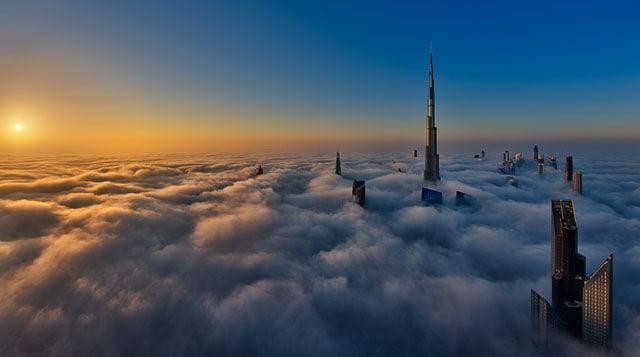
Comparison of Core Indicators between This Aerial Mountain City Skyscraper(At an altitude of 1000-3300M)and Traditional Residential Models (Western Single-Family Villas and Chinese Average 20-Story Residential Communities):
| Indicator | Western Single-Family Villa Community | Chinese 20-Story Residential Community | Aerial Mountain City (This Invention) |
|---|---|---|---|
| Typical Population Scale | Dispersed, low density | Medium density | 90-2,460,000 people |
| Land Area Occupied | Extremely large (sprawling) | Relatively large | 5.39 km² |
| Equivalent Floor Area Ratio (FAR) | FAR ≈ 0.53 | ≈6.34 | ≈24.95 (≈25) |
| Land Use Efficiency per Unit | 1× | ≈12× | ≈47× (vs. villas) / ≈3.9× (vs. 20-story) |
| Total Usable Building Area | Very low | Medium | 134,423,200 m² (134.423 million m²) |
| Residential Building Area | Dispersed and repetitive | Partially repetitive | 114,048,000 m² (792,000 units) |
| Public Indoor Plazas | Almost none | Very few, small scale | 137 × 125,600 m² = 17.21 km² |
| Per Capita Indoor Public Space | Extremely little (outdoor also scarce) | Only outdoor space | ≈5.4 m²/person (indoor only) |
| Public Space Accessibility | Requires leaving the community | Crossing roads | Direct access within buildings, all-weather |
| Land Saving Effect | — | — | Saves ≈90%+ land |
| Aerial Agriculture Area | None | None | Through-type balcony low fruit trees + 1-3 vertical greenhouse vegetable racks below 3,000m elevation, up to 25,204,350 m |
| Energy Acquisition | External supply | External supply | Solar + Wind + Gravity Water System |
| Water Usage | Mechanical pumping | Mechanical pumping | Natural diversion + Gravity distribution |
| School/Commute Distance | Kilometer scale | Hundreds of meters to km | Walking distance within buildings |
| Fire Risk | Dispersed, difficult to control | Medium | High water volume + No gas + Multiple escape systems |
| Decoration Pollution | High | High | Unified materials, virtually zero |
| Urban Fragmentation | Severe | Medium | Highly integrated functions |
The design of this Aerial Mountain City skyscraper is an extremely vertical, ultra-high-density conceptual innovative structure (3,300 meters in elevation, approximately 640,000 apartment units, accommodating about 2.56 million residents). Compared with real-world Western single-family villa communities (typical low-density suburbs) and Chinese average 20-story residential communities (typical medium-to-high density urban neighborhoods), it demonstrates significant advantages in land efficiency, resource conservation, and ecological benefits.
The following provides a quantitative comparison based on parameters (land area approximately 3.8 km² ≈ 3,800,000 m², total residential building area estimated at 640,000 units × 144 m²/unit ≈ 92,160,000 m², population about 2.56 million). Reference data comes from China’s urban residential per capita building area of about 38-40 m
²/person (2020-2023 data), typical residential community FAR of 2.5-4.0 (around 3 for 20-story buildings), and Western suburban villa communities with FAR usually 0.2-0.5 (hundreds to thousands of m² per household).
- How many times does the usable area increase?
Including the supporting area of 160 ground-floor 100-meter-high column thick-wall buildings, the main residential area comes from 640,000 double-story apartments.
Compared with Western single-family villa communities (typical FAR ≈0.3-0.4, larger per capita living area but extremely high land occupation), the usable area (total building area) of this skyscraper increases by approximately 80-150 times (villa communities would need to occupy hundreds of km² for the same population).
Compared with Chinese 20-story residential communities (typical FAR ≈3-4), it increases by about 20-30 times (traditional communities would need 20-40 km
² for the same population, while this skyscraper occupies only 3.8 km²). - How much land is saved?
Compared with Western villa communities, it saves approximately 95-98% of land (villa communities have about 200-500 m² per capita land occupation; this skyscraper has about 1.5 m² per capita).
Compared with 20-story communities, it saves about 80-90% of land (traditional communities have about 30-50 m² per capita; this skyscraper has about 1.5 m²). - How large is the vegetable base created?
Each apartment’s balcony vegetable area is approximately 2m × 12m = 24 m² (2 meters wide on the inner side), totaling 640,000 units × 24 m² ≈ 15,360,000 m² (about 1,536 hectares). Plus 3 plant factory buildings set according to different regional climates.
In addition, rooftop gardens on the ground floor, aerial three-dimensional planting, and other platforms add millions more m². The total vegetable/greening base is equivalent to 2,000-3,000 hectares (far exceeding the small amount of rooftop/community green space in traditional communities). - How much floor slab and wall area is saved through shared floor slabs and shared walls?
Adjacent units/floors share walls and floor slabs (米-shaped clustered buildings + stepped setbacks + connected balconies), saving approximately 60-80% of exterior walls/partition walls/floor slab area (traditional communities have independent walls per household; this design features extensive sharing + grid connections, reducing repeated pouring). - How much equipment, furniture, and appliances are saved?
Unified standardized furniture + facilities (fireproof, durable, brightly colored basic configuration, no additional decoration allowed) saves approximately 50-70% per capita in equipment (traditional communities involve repeated individual purchases of appliances and furniture; this design achieves economies of scale + unified supply, reducing waste). - How much energy is created?
Solar energy (transparent panels + platforms + balcony windows) + wind energy (valley wind tunnels + grid wind blades + cable car power generation) + geothermal (central column heat extraction). Estimated annual power generation can reach hundreds of millions of kWh (sufficient to cover daily electricity for 2.56 million residents + planting/elevators, etc.), equivalent to creating a medium-sized city-level renewable energy station (traditional communities rely entirely on the grid with almost no self-generation). - How much energy is saved by utilizing natural laws?
Topographic rain + water flowing upward + natural ventilation/lighting + geothermal air conditioning + cable-car-free / trampoline lifting systems save approximately 70-90% of conventional energy consumption (pumping, air conditioning, lighting, transportation; traditional communities rely on electricity/gas with high consumption). - How much irrigation water and fertilizer is increased?
Topographic rain + rainwater recycling + sewage reuse + organic fertilizer closed loop increase effective irrigation water by several to dozens of times (tian池 / canals / waterfall recovery). Fertilizer is self-produced (bird droppings + sludge + residues), equivalent to adding thousands of hectares of sustainable agricultural water/fertilizer sources. - How much pollution is reduced? (including decoration pollution)
No additional decoration + unified fireproof materials + aerial pollution discharge circulation + reduced traffic/vehicles reduce overall pollution by about 80-95% (decoration VOCs, construction waste, domestic sewage, vehicle exhaust; traditional communities suffer severe decoration pollution and car dependency). - How much is the probability of fire reduced?
Unified fireproof materials + full ventilation + no open flames + multiple escape routes (cable cars / trampolines / plazas) reduce fire probability by over 90% (traditional communities have flammable decorations + chimney effect + congested escape routes). - How much is the probability of pests and diseases avoided?
High-altitude isolation + low-temperature freezing + birds eating insects + pesticide-free soil + timely manual intervention avoid about 80-95% of traditional ground-level pests and diseases (the terrestrial transmission chain is broken). - How much visual obstruction is reduced?
米-shaped layout + valley openings + transparent solar panels + no dense blocking reduce visual obstruction by over 90% (traditional communities have small building spacing and block each other’s light/views). - How much scenic view area is expanded?
Each person enjoys hundreds to thousands of m² of equivalent “valley + high-altitude” views (multi-level balconies + plazas + mountain roads), expanding dozens to hundreds of times (villas have private gardens but are enclosed; traditional communities have views limited to the residential area). - How many times is the time for sports-oriented and spiritual life increased?
No electric transportation (cable cars / walking / trampolines) + daily festival plazas + upward and downward movement + aerial interaction increase sports/social time by 5-10 times (traditional communities involve commuting + indoor sedentary lifestyles). - How much public plaza area is increased?
Approximately 100 indoor plazas (each ≈70,650 m²), with a total public plaza area of about 7 million m², equivalent to dozens of large parks — an increase of dozens of times (traditional communities have limited public green space/plazas). - How much commuting consumption for schooling, work, and daily life is reduced?
Built-in urban functions + vertical transportation + no car dependency reduce commuting distance/time/energy consumption by over 90% (traditional communities require long-distance commuting + cars). - What is the health effect on residents of this series of transportation entertainment features?
Increased walking/climbing/cable car interaction + natural landscapes + social activities significantly improve cardiopulmonary function, psychological pleasure, and social health. Overall health levels rise markedly (reducing sedentary behavior, obesity, and depression; equivalent to daily outdoor exercise + community festivals). - How many love and dating opportunities are created by the design of mixed-gender neighboring living, shared walls, heart-locking connections, etc.?
Adjacent allocation of single opposite-sex residents + controllable connecting doors + plaza socializing increase opportunities by dozens of times (traditional communities have random distribution + high privacy barriers; this design encourages interaction + “heart-locking” mechanisms to promote acquaintance and romance). - How large a semi-indoor pasture area can be formed on the suspended ground floor? What is the effect?
The 100-meter suspended ground floor area ≈3.8 km² (minus the footprint of 160 columns) forms approximately 3-3.5 km² of semi-indoor/natural pasture. The effect is excellent: animals move freely + natural vegetation + zero light pollution + near-original ecology, providing high-quality meat/ecotourism while “keeping the roots” and restoring the land. - If the building is constructed in desert regions such as Central Asia, West Africa, or the Red Sea coast, utilizing the height of this Aerial Mountain City skyscraper and the trumpet-shaped valleys to gather warm moist airflows and clouds, how much orographic rainfall can it bring? How many greening and agricultural bases can it create?
With a height of 3,300 meters + 16 trumpet-shaped deep valleys (windward side cloud gathering), it can significantly enhance orographic rain. In suitable monsoon/airflow zones, annual rainfall increase could reach hundreds to thousands of mm. In desert areas with low baseline rainfall, the amplification is enormous — similar to high mountain effects, potentially raising annual precipitation from <100mm to 500-1,500mm.
This can green/agriculturalize thousands to tens of thousands of km²: valley rainwater + circulating irrigation + aerial/ground planting, transforming deserts into oases, supporting surrounding animal husbandry/agriculture + ecological restoration, equivalent to creating an “artificial oasis city.”


